
A planner, whether paper or digital, only produces results if it aligns with how you process information and structure your days. The market today offers dozens of formats, from blank bullet journals to notification-laden apps, with none universally suitable. Choosing a planner that meets your needs first requires understanding what truly distinguishes these tools beyond their appearance.
Paper or digital: what memorization changes in daily organization
The question of format is not merely an aesthetic preference. A study reported by Femina in 2026, originally published in 2021, documents a paper advantage for memorizing appointments. The act of writing by hand engages different cognitive circuits than typing on a screen, which promotes the anchoring of information in long-term memory.
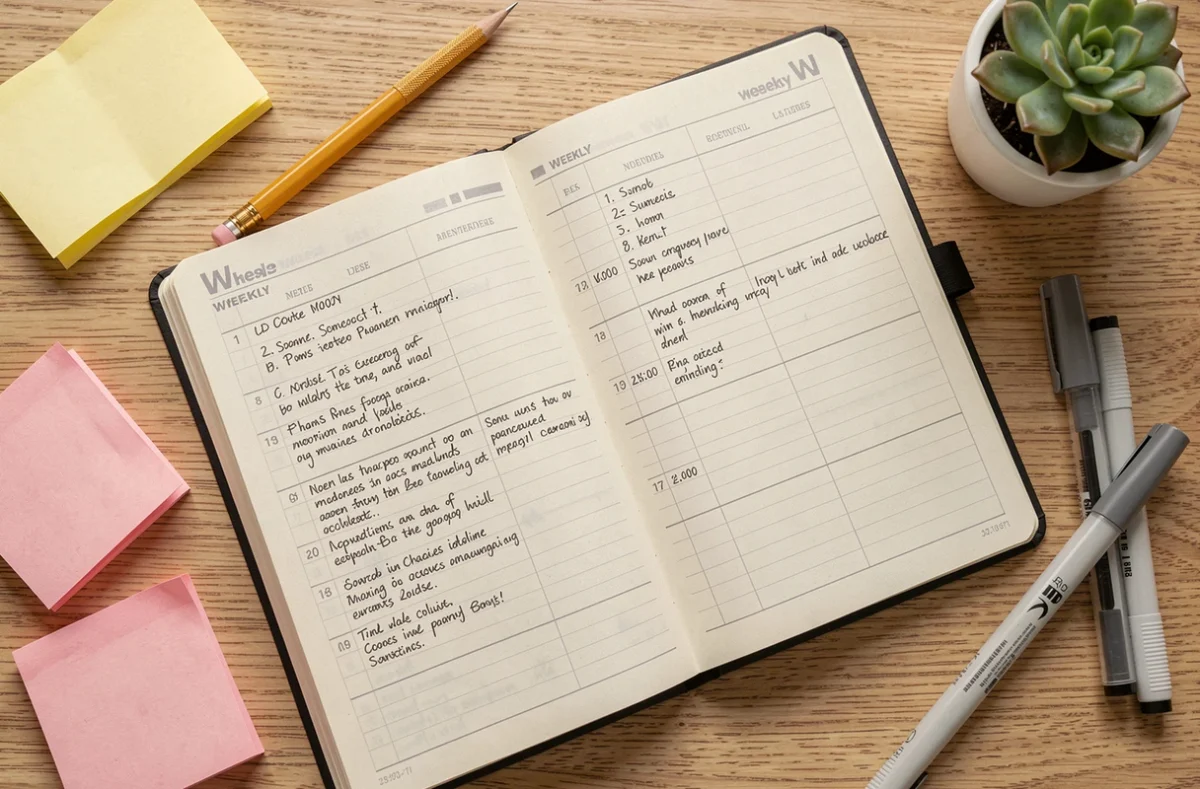
The paper planner also offers a physical overview that the screen struggles to replicate. When you open a planner to a double page, the entire week appears without scrolling or clicking. This spatial vision helps to spot areas of overload and free slots at a glance.
In contrast, digital remains superior for anything requiring actionable reminders and device synchronization. Tools like Babysteps Planner allow you to structure your daily tasks within a progressive framework, combining visual planning and regular tracking.
Field feedback often recommends a hybrid system where each format meets a specific need: paper for overall planning and reflection, digital for deadlines requiring notifications or shared reminders.

Reminder fatigue: when the digital planner becomes counterproductive
One of the blind spots in articles about daily organization concerns notification overload. Multiplying digital reminders seems logical to avoid forgetting anything. Recent usage feedback indicates the opposite: an accumulation of notifications leads to fatigue that causes all of them to be ignored.
This phenomenon significantly reduces the usefulness of a digital planner. If every task, even minor, triggers an alert, the brain stops processing these signals as priorities. The result is paradoxical: the more you plan, the less you execute.
The documented solution is to limit reminders to only those actions that require an immediate reaction and to phrase them in a directly actionable manner. An effective reminder contains a specific action (“send the quote to X”) rather than a vague title (“project Y”).
Criteria for deciding if a task deserves a reminder
- The task has a fixed deadline and a real risk of being forgotten (medical appointment, administrative deadline)
- It depends on a specific time slot that you do not naturally check in your paper planner
- Its omission would have a concrete consequence for another person (team deliverable, shared commitment)
Recurring tasks without urgency (organizing a file, checking on a personal project) benefit from remaining on a paper list reviewed during a weekly routine, without notification.
Planner and neurodivergence: interfaces that change the game
Standardized planners pose a specific problem for neurodivergent individuals. A classic task list, ordered by hour, assumes a linear perception of time that does not fit all cognitive functioning modes.
Specialized applications now integrate pictograms, countdowns, and transition alerts rather than just a simple text list. This visual and temporal approach gained visibility after Tiimo won the iPhone App of the Year award at the Apple App Store Awards 2025.
The issue goes beyond comfort: for a person with ADHD, the difficulty lies not in a lack of will but in managing transitions between activities. A planner that visually signals the transition from one task to another, with a countdown rather than a fixed hour, reduces the cognitive friction associated with context changes.
The available data does not allow for a conclusion that one format (paper or digital) is systematically more suitable for neurodivergent profiles. Field feedback varies on this point, and the choice largely depends on the type of neurodivergence and the compensatory strategies already in place.
Building a planning routine that lasts
The most suitable planner in the world is useless without a routine of regular consultation. Most dropouts occur in the first few weeks, not because the tool is bad, but because the habit of opening it has not been established.
Two key moments structure an effective routine:
- A short evening review (a few minutes) to note the tasks for the next day and assess what has been accomplished or postponed
- A longer weekly review to adjust the goals for the following week and identify tasks without deadlines that are piling up
- A monthly check-in to verify alignment between daily tasks and medium-term goals
The evening review works better than morning planning for a simple reason: it avoids starting the day with a decision-making phase. When priorities are already written down, the morning begins with action rather than arbitration.
The trap of overplanning
Filling every time slot in a day gives an illusion of control. In practice, a day without room for adjustment derails at the first unexpected event. Planning empty slots in your planner is not a sign of underutilization: it is a condition for planning to remain sustainable over several months.
A planner suited to your needs is one that you open every day effortlessly. The format, medium, and level of detail matter less than the regularity with which you use it. Testing a system for three to four weeks before modifying it remains the only reliable way to know if it suits you.